.png)
Assignment Structure and Overthinking
- dannysnee5
- May 5
- 3 min read
Introduction
Whether you are working out how to order the body paragraphs of an argumentative essay or polishing the executive summary of a mock business report, getting to grips with assignment structure can be difficult for students. It would be irresponsible to suggest that assignment structure is not important, but it is important to remember that you don’t have to have it all worked out the moment you start writing.
Body Paragraph 1
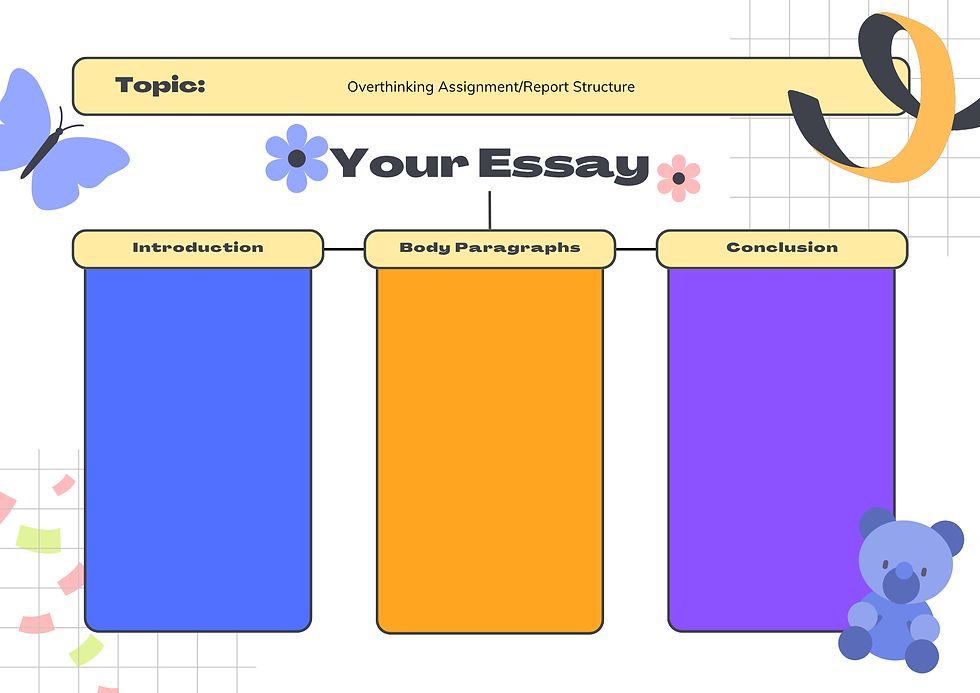
Assignment structure refers to how students put together an assessment document at school, TAFE, or university. Issues such as choosing what information to include and which references to cite may be viewed as adjacent to assignment structure. Students will all be familiar with the standard three-part essay, divided into an introduction, multiple body paragraphs, and a conclusion. The structure of a scientific/business report can be more complicated, but plenty of relevant information can be found online. Essays and reports can both be improved through use of the PEEL structure, which dictates that each paragraph include, (1) The point/claim you wish to make, (2) The evidence for your claim, (3) Further explanation of this evidence, and (4) A sentence or two linking the paragraph back to the main thesis of the assignment. You should also link each paragraph to the topic that you intend to discuss in the next paragraph (such as the reasons why students find assignment structure difficult or why they should avoid overthinking it).
Body Paragraph 2
Simply put, assignment structure is difficult because it involves harmonising multiple different elements of your assignment. Students find themselves rummaging through the jigsaw pieces represented by their main arguments, the research to be drawn upon, pertinent anecdotes, and tonal elements, such as language choice. You may also realise that you have devoted an entire body paragraph of an essay to a topic that you cannot find sufficient research about. In a study by Krause (2001), a sample of 46 university students were instructed to rank 10 different aspects of essay writing in order of difficulty. On average, students tended to rate ‘working out which resources to include and which to emit’ as the second hardest aspect of essay writing, while ‘Finding relevant references by searching library computer databases (e.g., ERIC)’ was rated as the most difficult item (Krause, 2001). A good decision to make when facing these difficulties can sometimes be to just start writing.
Body Paragraph… what are we up to?
Although it is important for your work to have a clear structure, I would not recommend obsessing too much about structure when you are first wading into the task of writing about a new topic. It is a balancing act of avoiding wasting time barking up the wrong tree because you didn’t plan, while also avoiding situations where you spend so much time planning (or procrastinating the daunting task of planning) that you run out of time to write and polish the assignment. Following on from this, it is important to remember that the process of writing can serve as an aid to thinking and reasoning. This is partly because writing allows us to externalise information while solving problems, rather than having to hold everything in memory (Ghilic, 2022). However, writing also helps to engage the brain’s prefrontal cortex, providing us with a greater ability to connect different ideas together (Roberts, 2021). Once you have dived into your writing, you will likely find the grand picture becoming progressively clearer.
Conclusion
The conclusion is always the hardest part. Don’t worry, it will all come together.
References
Ghilic, I. (2022). Cognitive offloading and note-taking: Identifying the gaps between applied research and inclusive learning design [Doctoral dissertation]. McMaster University. http://hdl.handle.net/11375/28232
How to write a report. (n.d.). QUT cite|write. https://www.citewrite.qut.edu.au/write/writing-well/report.html
Krause K. (2001). The University Essay Writing Experience: A pathway for academic integration during transition. Higher Education Research & Development, 20(2), 147-168. https://doi.org/10.1080/07294360123586
Roberts, C. (2021). Writing with the brain in mind. Atkins H S & Carver L (Eds.), Writing is thinking: Strategies for all content areas, (p. 17–34). Bloomsbury Publishing. https://doi.org/10.5040/9798216402381.ch-2


Comments